
Share Michael Shulha's obituary with others.
Invite friends and family to read the obituary and add memories.
Stay updated
We'll notify you when service details or new memories are added.
You're now following this obituary
We'll email you when there are updates.
Select your format and elements to print

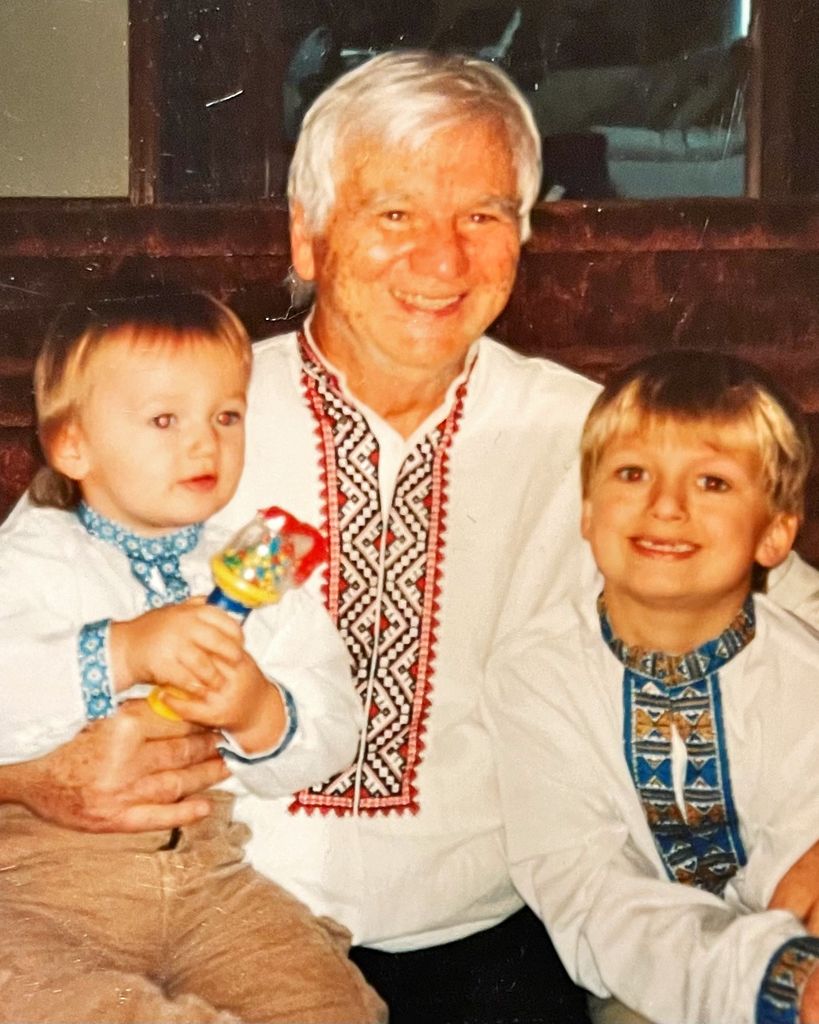


Michael Shulha
Nov 21, 1930 — May 3, 2026
Михайло Іванович Шульга
Mykhailo Ivanovych Shulha
November 21, 1930 – May 3, 2026
Remembering Mykhailo Shulha: A Life of Faith, Family, and a Kozak’s Heart for Ukraine
Michael Shulha, known in the Ukrainian community as Mykhailo, passed away on May 3, 2026, at the age of 95. He is lovingly remembered by many names: “Mish” to his wife, Marusia; “Tato” to his daughter, Halya and his son-in-law, Danko; “Dido” to his grandsons, Adam and Pavlo; “Kum” to his closest friends Halya and her late husband, Volodymyr; “Dyadya Maho” to his goddaughter, Oksana; and “Svat” to Halya’s in-laws, Evhen and Maria. Those who knew Mykhailo remember him as thoughtful and silver-haired, measured in his words and actions, deeply sensitive to the pain of others, and devoted to charity. His peaceful nature was not weakness; it was his strength. He moved mountains gently.
Mykhailo was born on November 21, 1930, on the feast day of the Archangel Michael, near Lebedyn in Sumy Oblast, Ukraine, in the village area of Shulhivka. His childhood was shaped by the sorrows and trials of twentieth-century Ukraine. His parents labored under the Soviet collective farm system, and from his earliest years he learned endurance, simplicity, humility, and faith.
As a child, Mykhailo survived the Holodomor, the man-made famine engineered by Stalin’s Soviet regime that devastated Ukraine. His family endured hunger beyond imagination. At one point, his mother boiled a hide from dead livestock with chaff to make an ersatz soup, a desperate substitute made from whatever inedible or barely edible materials could be found when real food was unavailable. That meager nourishment was likely the only reason his family survived. The memory stayed with him and became part of the deep well of compassion that marked his life.
His childhood was also marked by hardship and danger. Because the Soviet authorities forced his parents to labor long hours on the kolhoz (a collective farm), Mykhailo was often left to fend for himself throughout the day. In those difficult, unsupervised years, he survived near drownings, falls from trees, and a broken leg that left him hospitalized for nine months. Yet through it all, he grew into a man of quiet strength, patience, and resilience.
During the Second World War, Mykhailo and his family were caught between two brutal forces: the Soviet forces advancing from the east and the Nazi forces pressing from the west. Their village in Sumy Oblast had become a place of danger from both directions, but for his family the Soviet threat was the most immediate and personal. Mykhailo’s father had escaped from the Soviet army and was regarded as a political dissident, making the family especially vulnerable to punishment if they fell back under Soviet control. They did not know what awaited them, but they knew they had to flee. Leaving behind their home, their village, and all that was familiar, the family fled west in search of survival. Eventually, they found themselves on a labor farm in Austria.
When the war ended and Nazi Germany was defeated, another danger emerged. Displaced families were being gathered and sent back to their places of origin. For Mykhailo’s family, returning to their village under Soviet control would have certainly meant imprisonment, exile to Siberia, or death. For them, repatriation was not a safe return home, but a probable death sentence.
One day, while walking home from the labor farm, Mykhailo’s father met a priest who told him about a nearby refugee camp. That chance encounter changed the course of the family’s life. Rather than risk forced repatriation to Soviet-controlled Ukraine, the family fled once again, this time to the safety of a Red Cross camp. During those years in the displaced-persons camp, Mykhailo learned enough English to help others complete the applications and documents required for emigration. That work gave him a longing for America. After the war, as countries slowly began opening their borders to refugees, many people in the camp left as soon as they could for Argentina, Canada, Australia, and elsewhere. But Mykhailo had his heart set on America, even though the United States had not yet opened its doors to refugees like his family. He convinced his parents to wait. At last, when the opportunity finally came to apply for admission to the United States, the family applied. Their patience was rewarded: they were accepted for resettlement and selected for passage to the United States, entering their new country through Ellis Island.
After entering the United States in September 1949, Mykhailo and his family settled in Pittsburgh, Pennsylvania, with the support of the Ukrainian community and St. Mary’s Ukrainian parish. Like many Ukrainian immigrant families of that generation, they started over through hard work, faith, and gratitude. After saving enough to continue his education, Mykhailo enrolled at Duquesne University in 1956 and graduated in August 1959 with a bachelor’s degree in commercial sciences. He was briefly married and had a daughter, Tamara. Soon thereafter, Mykhailo relocated to New Jersey and began a long career in commercial computer systems, working as a software programmer until his retirement in September 1994.
Mykhailo’s life in America was inseparable from service to his church, his community, and his beloved Ukraine. He was active in Ukrainian church and civic life, including the League of Orthodox Youth, the Brotherhood of St. Andrew, the Ukrainian studies school parent committee, the Ukrainian Federal Credit Cooperative, and the Ukrainian youth organization ODUM. In these organizations, he served in many roles, including secretary, cultural-education officer, chair of committees, and community leader.
He later became President of the Committee to Aid Ukraine in New Jersey, a role that reflected the deepest commitments of his heart. Through that work, he helped support disabled orphans in a Dnipropetrovsk orphanage, assisted the Ukrainian school-gymnasium in Simferopol, supported Sumy-region graphic artist Mykola Bondarenko in the publication of the Holodomor art and research album “Ukraine-1933: Culinary Book,” and aided civic organizations and individuals in need across Ukraine. His charity was not abstract; it was personal, practical, and faithful.
Mykhailo loved Ukrainian life, Ukrainian traditions, and Ukrainian joy. He loved to dance and often attended Ukrainian zabavas, where he, Marusia, and their dear friends Volodymyr and Halya Hrehorenko were often among the last to leave after many evenings of music, dancing, and fellowship. It was at a zabava in South Bound Brook, New Jersey, that he met the love of his life, Marusia. They met at that dance and danced the night away. During the evening, she offered to read his palm and tell him his future. Mykhailo agreed, and Marusia told him that one day he would marry her. A few months later they were married, and on July 11, 1972, their daughter, Halya, was born.
He passed this love of Ukrainian culture to his daughter, introducing her to Ukrainian dancing from an early age. She studied under Pani Roma Pryma Bohachevsky, the late founder of the renowned NYC-based dance ensemble Syzokryli. In 1992, Mykhailo experienced the glorious joy of returning to Ukraine for the first time since fleeing during the war. He traveled with his daughter as she performed with the dance ensemble Syzokryli in cities across Ukraine. While in Kharkiv in eastern Ukraine, they found a driver who knew the region and were able to return to the village and home that Mykhailo had fled decades earlier. There, he found neighbors and cousins who were astonished and deeply moved to see him return. It was an overwhelmingly emotional experience for him and for his daughter, a sacred return to the soil, memory, and family from which history had torn him.
Above all, Mykhailo was a family man. Marusia was the love of his life, and together they shared 54 joyful, love-filled years of marriage. Their bond was one of devotion, tenderness, loyalty, and deep faith.
He loved his daughter Helen, his Halya, with all his heart. They shared a deep and loving bond unlike any other. His love for her was constant, protective, proud, and gentle. He was also deeply fond of her husband, Danylo, whom he regarded in every true sense as a son. Their bond was marked by love, affection, and respect.
He loved his grandsons beyond words. Adam “Dasio,” born May 8, 2000, and Pavlo “Lucio,” born October 10, 2005, were two lights of joy in his life. He took them fishing many times, taught them chess, taught them to read and write in Ukrainian, and delighted in taking them to Red Lobster. His time with them was filled with patience, pride, laughter, and love.
Mykhailo is survived by his beloved wife, Marusia; his daughter, Tammy; his daughter, Halya, an attorney, and her husband and Mykhailor’s son-in-law, Danylo Oscislawski, a physician; and Halya and Danylo’s sons, Mykhailo’s cherished grandsons, Adam “Dasio” Oscislawski and Pavlo “Lucio” Oscislawski.
He touched many lives. He valued simplicity, family, faith, Ukrainian tradition, and his beloved Ukraine. He gave all glory to God and believed that all things are God’s will. He lived as an example of gentleness, humility, service, and love.
He will be missed profoundly, but he will never be forgotten.
May his memory be eternal. Вічная пам’ять.
* * * *
Mykhailo will be laid to eternal rest on Saturday May 23, 2026, at St. Andrew Ukrainian Orthodox Cemetery, located at 280 Main Street, South Bound Brook, New Jersey 08880. A funeral liturgy will be held that morning at 9:00 a.m., followed immediately by burial. The church panahyda will be open-casket; there will be no additional viewing.
All arrangements are under the care and supervision of Hagan-Chamberlain Funeral Home.
Service Schedule
Past Services
Liturgy
Saturday, May 23, 2026
9:00 - 10:00 am (Eastern time)
St. Andrew's Memorial U. O. Church
Burial
Saturday, May 23, 2026
St. Andrew's Memorial U. O. Church
Guestbook
Visits: 406
This site is protected by reCAPTCHA and the
Google Privacy Policy and Terms of Service apply.
Service map data © OpenStreetMap contributors